01Scarcity → Exploration
Idea abundance
AI multiplies the number of directions a person can examine. The value is not in generating everything; it is in discovering which direction contains signal.
AI does not replace human purpose. It changes the economics of creation—making ideas abundant, execution more accessible, and discernment more valuable.
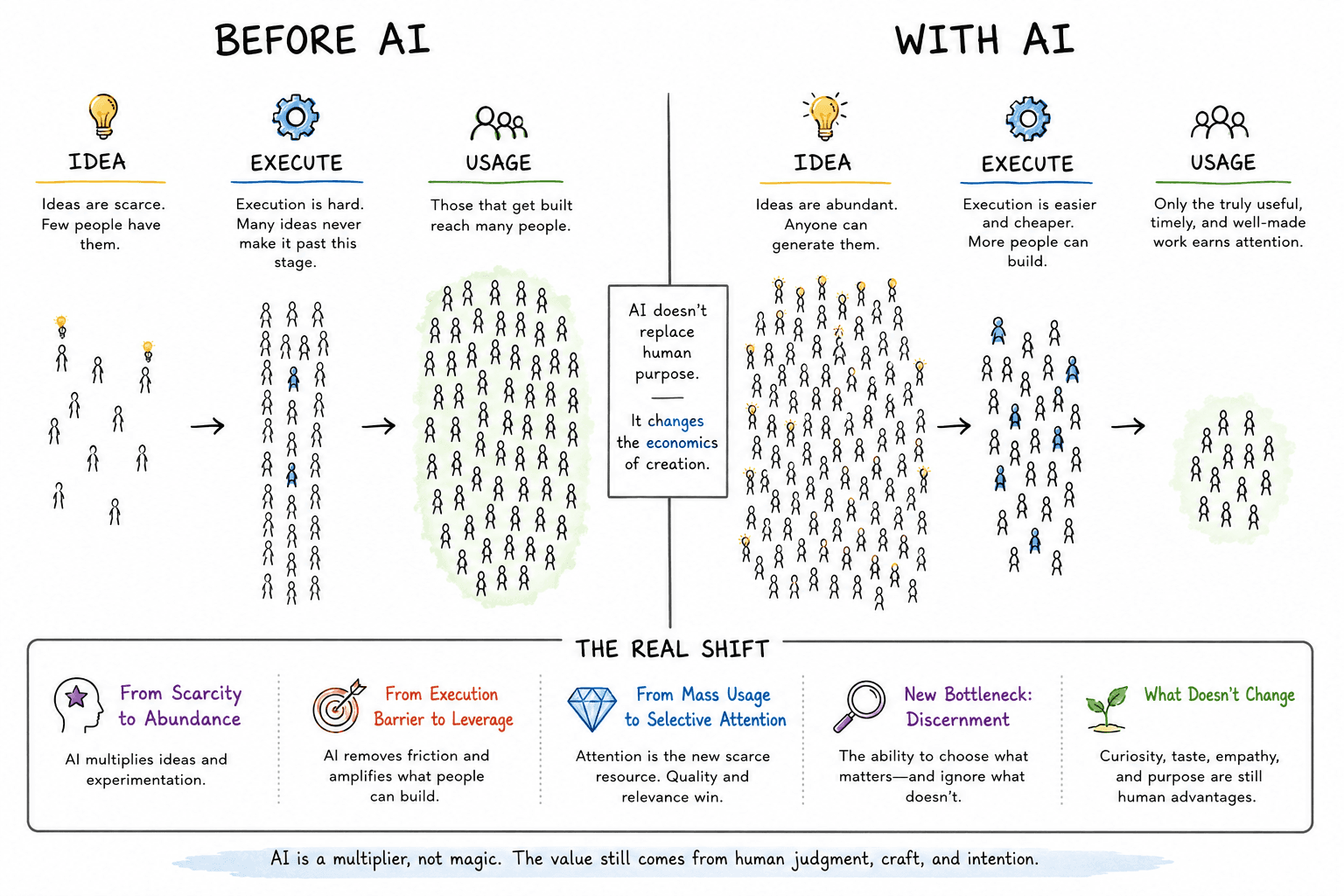
The corrected model
The mistake is measuring AI only by how many finished products become mass-market successes. Its deeper use appears throughout the process: thinking, exploring, prototyping, understanding, correcting, and deciding.
DISCERNMENT MODEL
When generation becomes abundant, the scarce resource is no longer the ability to make something. It is the ability to recognize what deserves to be made, refined, trusted, and used.
Observed coordinate
MIRROR // SHIFT
Purpose
Human origin
The reason for making the work still begins outside the tool.
Discernment
New bottleneck
Taste, judgment, restraint, verification, and context determine what survives abundance.
Attention
Earned signal
Useful work earns attention by resolving a real need or carrying genuine meaning.
Five movements
A larger field creates more noise, but it also creates more entry points, more experimentation, and more opportunities for people who were previously blocked from expressing what they could see.
AI multiplies the number of directions a person can examine. The value is not in generating everything; it is in discovering which direction contains signal.
A single creator can research, prototype, test, rewrite, debug, and visualize farther than before. Leverage expands the hand; it does not choose the destination.
Abundant creation does not produce abundant attention. People still return to work that is useful, resonant, trustworthy, timely, or unmistakably alive.
The new competitive edge is knowing what to ignore, what to verify, what to refine, and what should never leave the draft stage.
Curiosity, empathy, taste, responsibility, lived context, and purpose remain the source of direction. The system can amplify the signal, but it cannot become the reason.
People often ask what they can extract from AI. A more useful question is what their interaction with it reveals: the assumptions they repeat, the questions they avoid, the taste they exercise, and the intent they bring into the mirror.
INPUT
Questions, experiences, references, constraints, curiosity, wounds, knowledge, and intent.
REFLECTION
Patterns, possibilities, language, structure, contrast, recombination, and probabilistic response.
AUTHORSHIP
Selection, verification, meaning, responsibility, refinement, refusal, and the decision to act.
The new bottleneck
Discernment is the ability to recognize what deserves attention, where the model is wrong, when speed has outrun intention, and whether the result carries enough truth to become more than output.
“AI is a multiplier, not magic. The value still comes from human judgment, craft, and intention.”